PROJECT OVERVIEW
PROJECT OVERVIEW
Transforming a Blog Site into a Lead Generating Brand
Transforming a Blog Site into a Lead Generating Brand
The Word Count is a growing publishing company that supports up-and-coming writers throughout the publishing process. The brand offers editing, consulting, and marketing services, along with a blog designed to educate and guide aspiring authors.While the founder had a clear vision for empowering writers, the original site functioned primarily as a personal blog rather than a strategic business platform. The website lacked clear positioning, defined service offerings, and structured pathways for engagement, making it difficult to communicate value or generate leads. To support the brand’s evolution, the experience needed to shift from content-focused to conversion-driven, transforming the platform into a professional, user-centered website designed to attract, nurture, and grow its audience while scaling alongside the business.
The Word Count is a growing publishing company that supports up-and-coming writers throughout the publishing process. The brand offers editing, consulting, and marketing services, along with a blog designed to educate and guide aspiring authors.While the founder had a clear vision for empowering writers, the original site functioned primarily as a personal blog rather than a strategic business platform. The website lacked clear positioning, defined service offerings, and structured pathways for engagement, making it difficult to communicate value or generate leads. To support the brand’s evolution, the experience needed to shift from content-focused to conversion-driven, transforming the platform into a professional, user-centered website designed to attract, nurture, and grow its audience while scaling alongside the business.

Project Duration
Project Duration
4 Weeks
4 Weeks
Platform
Platform
Wordpress
Wordpress
Role
Role
UX Designer, UX Researcher
UX Designer, UX Researcher
Tools
Tools
Figma, Google Forms, Elementor
Figma, Google Forms, Elementor
THE CHALLENGE
THE CHALLENGE
Unclear Value Communication
and Weak Conversion Signals
Unclear Value Communication and Weak Conversion Signals
Unclear Value Communication and Weak Conversion Signals
The existing homepage did not clearly guide first-time visitors or communicate The Word Count’s value with confidence. Key information about services, expertise, and next steps was buried in dense text, increasing cognitive load and making it difficult for aspiring authors to understand how the company could support their publishing journey. Inconsistent visual hierarchy, weak trust signals, and the absence of a clear primary call-to-action reduced perceived professionalism and credibility, ultimately limiting the site’s ability to establish authority and convert visitors into engaged leads.
The existing homepage did not clearly guide first-time visitors or communicate The Word Count’s value with confidence. Key information about services, expertise, and next steps was buried in dense text, increasing cognitive load and making it difficult for aspiring authors to understand how the company could support their publishing journey. Inconsistent visual hierarchy, weak trust signals, and the absence of a clear primary call-to-action reduced perceived professionalism and credibility, ultimately limiting the site’s ability to establish authority and convert visitors into engaged leads.
THE SOLUTION
THE SOLUTION
Rebuilding Trust and Creating
a Clear Path to Engagement
Rebuilding Trust and Creating
a Clear Path to Engagement
Rebuilding Trust and Creating a Clear Path to Engagement
The redesign transformed the homepage into a clear, authority-building experience designed to guide first-time visitors toward meaningful engagement. I restructured the information architecture, strengthened the visual hierarchy, and surfaced key services and next steps to reduce cognitive load and clarify the brand’s value. Strategic placement of testimonials, refined service sections, and a prominent primary call-to-action reinforced credibility and professionalism, ultimately positioning The Word Count to establish trust and convert visitors into engaged leads.
The redesign transformed the homepage into a clear, authority-building experience designed to guide first-time visitors toward meaningful engagement. I restructured the information architecture, strengthened the visual hierarchy, and surfaced key services and next steps to reduce cognitive load and clarify the brand’s value. Strategic placement of testimonials, refined service sections, and a prominent primary call-to-action reinforced credibility and professionalism, ultimately positioning The Word Count to establish trust and convert visitors into engaged leads.
Design Process
Design Process
1
Empathize
Empathize
Conducted a heuristic evaluation, competitive analysis, and user survey.
Conducted a heuristic evaluation, competitive analysis, and user survey.
2
Define
Define
Synthesized research findings into key insights, a problem statement, and a site map.
Synthesized research findings into key insights, a problem statement, and a site map.
3
Ideate
Ideate
Generated “How Might We” questions and brainstormed design solutions.
Generated “How Might We” questions and brainstormed design solutions.
4
Prototype
Prototype
Created low and high-fidelity wireframes to visualize potential solutions.
Created low and high-fidelity wireframes to visualize potential solutions.
5
Test
Test
Conducted usability testing with target users to gather feedback on the prototypes.
Conducted usability testing with target users to gather feedback on the prototypes.
HEURISTIC EVALUATION
HEURISTIC EVALUATION
Identifying Usability Gaps
Identifying Usability Gaps
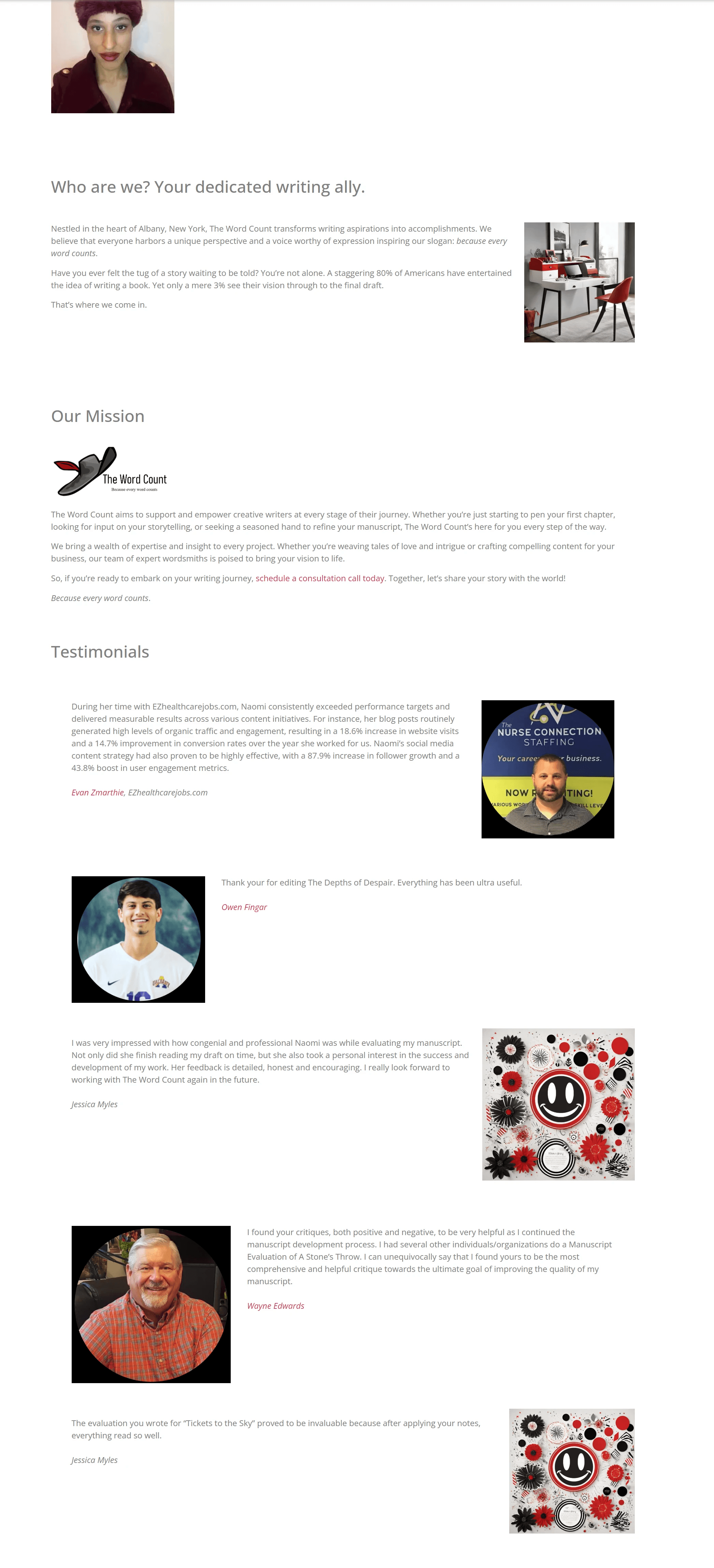
When I first landed on the homepage, several friction points were immediately apparent. To ground my observations in structured analysis, I conducted a heuristic evaluation to systematically assess how these usability gaps were impacting user behavior. What initially seemed like surface-level inconsistencies revealed deeper issues related to clarity, hierarchy, and direction. This structured analysis not only clarified where the experience was breaking down, but also uncovered underlying barriers that were limiting trust formation and conversion.
When I first landed on the homepage, several friction points were immediately apparent. To ground my observations in structured analysis, I conducted a heuristic evaluation to systematically assess how these usability gaps were impacting user behavior. What initially seemed like surface-level inconsistencies revealed deeper issues related to clarity, hierarchy, and direction. This structured analysis not only clarified where the experience was breaking down, but also uncovered underlying barriers that were limiting trust formation and conversion.
Hero Section Lacks Clear User Direction
Hero Section Lacks Clear User Direction
Users may feel uncertain about how to engage with the site or what the most important action is due to the following issues:
Users may feel uncertain about how to engage with the site or what the most important action is due to the following issues:
The homepage does not clearly communicate what actions users can take next.
The homepage does not clearly communicate what actions users can take next.
There is no strong primary call-to-action (CTA) above the fold to guide authors toward consultations, services, or blog content.
There is no strong primary call-to-action (CTA) above the fold to guide authors toward consultations, services, or blog content.
Lack of Visual Hierarchy
Lack of Visual Hierarchy
The experience feels cluttered and unpolished, which undermines perceived professionalism and credibility of the business.
The experience feels cluttered and unpolished, which undermines perceived professionalism and credibility of the business.
The page relies heavily on long paragraphs with limited visual hierarchy.
The page relies heavily on long paragraphs with limited visual hierarchy.
Testimonials takes up 80% of the home page.
Testimonials takes up 80% of the home page.
Lack of Consistency
Lack of Consistency
Inconsistencies make the site feel less intentional and may reduce user trust in the brand.
Inconsistencies make the site feel less intentional and may reduce user trust in the brand.
Typography, spacing, and image alignment are inconsistent across sections.
Typography, spacing, and image alignment are inconsistent across sections.
Visual patterns (headings, content blocks, imagery) are not reused consistently.
Visual patterns (headings, content blocks, imagery) are not reused consistently.
COMPETITIVE ANALAYSIS
COMPETITIVE ANALAYSIS
How Competitors Support Authors
How Competitors Support Authors
Following the heuristic evaluation, I examined how The Word Count compared to established competitors across homepage clarity, navigation, pricing transparency, support resources, and submission workflows.
Following the heuristic evaluation, I examined how The Word Count compared to established competitors across homepage clarity, navigation, pricing transparency, support resources, and submission workflows.
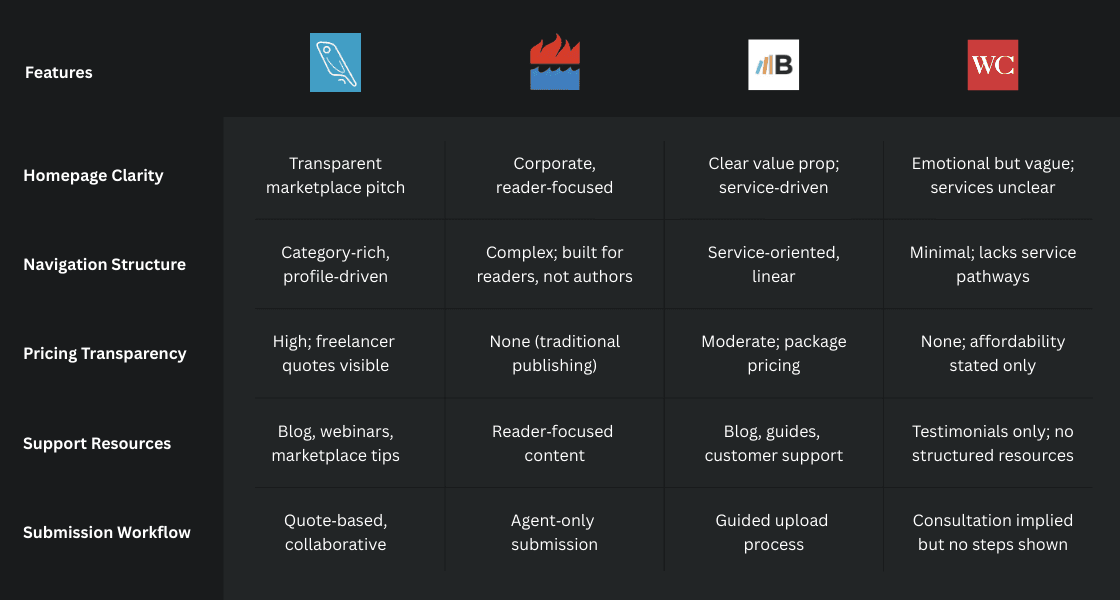
Clear patterns emerged. Competitors explicitly defined their services, structured navigation around user needs, and provided visible pathways for pricing and submission. In contrast, The Word Count relied more on implied messaging, minimal navigation, and an unstructured consultation process.
Clear patterns emerged. Competitors explicitly defined their services, structured navigation around user needs, and provided visible pathways for pricing and submission. In contrast, The Word Count relied more on implied messaging, minimal navigation, and an unstructured consultation process.
While credibility was present, it was not strategically surfaced. This comparison revealed that the gap was not in expertise, but in clarity, structure, and direction, all critical factors in building trust and driving engagement.
While credibility was present, it was not strategically surfaced. This comparison revealed that the gap was not in expertise, but in clarity, structure, and direction, all critical factors in building trust and driving engagement.
KEY INSIGHTS
KEY INSIGHTS
What Was Limiting Engagement
What Was Limiting Engagement
As I analyzed the homepage through heuristic evaluation and competitive comparison, recurring patterns surfaced. What seemed like isolated usability concerns pointed to broader challenges impacting credibility and conversion.
As I analyzed the homepage through heuristic evaluation and competitive comparison, recurring patterns surfaced. What seemed like isolated usability concerns pointed to broader challenges impacting credibility and conversion.
Users Want Social Proof
Users Want Social Proof
The competitive analysis revealed that credibility functions as a primary conversion trigger in this industry. Competitors surfaced testimonials, work samples, and team expertise immediately, signaling authority and trust within seconds. Although The Word Count included testimonials and client logos, these trust signals were not strategically prioritized within the visual hierarchy, reducing their impact and delaying user confidence. This revealed that aspiring authors needed immediate reassurance and visible proof of expertise before they were willing to engage.
The competitive analysis revealed that credibility functions as a primary conversion trigger in this industry. Competitors surfaced testimonials, work samples, and team expertise immediately, signaling authority and trust within seconds. Although The Word Count included testimonials and client logos, these trust signals were not strategically prioritized within the visual hierarchy, reducing their impact and delaying user confidence. This revealed that aspiring authors needed immediate reassurance and visible proof of expertise before they were willing to engage.
The Hero Section Lacked Service Clarity
Analysis of the homepage revealed that the current site did not clearly define its services, relying on implied meaning rather than explicit value communication. Additionally, although testimonials occupied a significant portion of the homepage, they appeared before a clear articulation of services. This sequencing created a disconnect. Users were presented with proof of satisfaction before fully understanding the offering itself. The insight was clear: credibility and social proof are most effective when anchored to a clearly defined service proposition.
A Polished, Structured Design Builds Credibility.
Competitive analysis revealed that a polished, well-structured website is a fundamental requirement in this industry. To be perceived as an established business, the site first needed to reflect the same level of professionalism and structure as its competitors before it could meaningfully stand out.
Competitive analysis revealed that a polished, well-structured website is a fundamental requirement in this industry. To be perceived as an established business, the site first needed to reflect the same level of professionalism and structure as its competitors before it could meaningfully stand out.
Users Need Clear Direction.
The heuristic evaluation revealed that the homepage lacked clear pathways and visual cues, leaving users uncertain about where to begin or what action to take next. While information was present, it did not translate into momentum. Without explicit guidance, first-time visitors were required to decide their own journey, increasing friction and reducing the likelihood of engagement. This demonstrated that without clear direction, even interested users may hesitate, ultimately limiting conversion.
The heuristic evaluation revealed that the homepage lacked clear pathways and visual cues, leaving users uncertain about where to begin or what action to take next. While information was present, it did not translate into momentum. Without explicit guidance, first-time visitors were required to decide their own journey, increasing friction and reducing the likelihood of engagement. This demonstrated that without clear direction, even interested users may hesitate, ultimately limiting conversion.

USER PERSONA
USER PERSONA
Defining the Primary User
Defining the Primary User
Maya has poured her heart into her first manuscript but feels overwhelmed by the complexity of the publishing world. She is visiting The Word Count for the first time, looking for guidance. She needs to quickly determine whether this agency is professional, credible, and capable of supporting her journey, and may hesitate if the site does not clearly communicate its services or guide her toward a confident next step.
Maya has poured her heart into her first manuscript but feels overwhelmed by the complexity of the publishing world. She is visiting The Word Count for the first time, looking for guidance. She needs to quickly determine whether this agency is professional, credible, and capable of supporting her journey, and may hesitate if the site does not clearly communicate its services or guide her toward a confident next step.
Background
Background
Name: Maya
Name: Maya
Age: 35
Age: 35
Occupation: Independent Author
Occupation: Independent Author
Education: BA in Creative Writing
Education: BA in Creative Writing
Goals
Goals
Full-time college student and leader of campus book club
Full-time college student and leader of campus book club
Passionate about fiction; frequently purchases books outside of class
Passionate about fiction; frequently purchases books outside of class
Buys textbooks occasionally, but leisure reading is her priority
Buys textbooks occasionally, but leisure reading is her priority
Behaviors
Behaviors
Full-time college student and leader of campus book club
Full-time college student and leader of campus book club
Passionate about fiction; frequently purchases books outside of class
Passionate about fiction; frequently purchases books outside of class
Buys textbooks occasionally, but leisure reading is her priority
Buys textbooks occasionally, but leisure reading is her priority
Pain Points
Pain Points
Full-time college student and leader of campus book club
Full-time college student and leader of campus book club
Passionate about fiction; frequently purchases books outside of class
Passionate about fiction; frequently purchases books outside of class
Buys textbooks occasionally, but leisure reading is her priority
Buys textbooks occasionally, but leisure reading is her priority


PROBLEM STATEMENT
PROBLEM STATEMENT
Barriers to Clarity, Credibility, and Conversion
Barriers to Clarity, Credibility, and Conversion
Aspiring and first-time authors visiting The Word Count website struggled to quickly understand what services were offered and how to move forward. While credibility signals such as testimonials and client logos were present, they were not strategically prioritized or anchored to a clearly defined service proposition. The homepage communicated passion and expertise, but lacked structured pathways, explicit calls to action, and visual hierarchy to guide users toward engagement. As a result, the experience limited trust formation, reduced clarity, and hindered conversion.
Aspiring and first-time authors visiting The Word Count website struggled to quickly understand what services were offered and how to move forward. While credibility signals such as testimonials and client logos were present, they were not strategically prioritized or anchored to a clearly defined service proposition. The homepage communicated passion and expertise, but lacked structured pathways, explicit calls to action, and visual hierarchy to guide users toward engagement. As a result, the experience limited trust formation, reduced clarity, and hindered conversion.
SUCCESS CRITERIA
SUCCESS CRITERIA
What Success Looks Like
What Success Looks Like
Before moving into design, I met with the site owner to align on goals, expectations, and what success would look like. Rather than assuming improvements would be measured by aesthetics alone, we defined clear criteria around clarity, credibility, and conversion.
Before moving into design, I met with the site owner to align on goals, expectations, and what success would look like. Rather than assuming improvements would be measured by aesthetics alone, we defined clear criteria around clarity, credibility, and conversion.
Goals:
Goals:
Clearly Communicate
Services & Value
Clearly Communicate Services & Value
Users should quickly understand what business offers and how it supports authors.
Users should quickly understand what business offers and how it supports authors.
Provide Clear
Directions
Provide Clear Directions
Primary call to actions should be immediately visible, reducing uncertainty and cognitive load.
Primary call to actions should be immediately visible, reducing uncertainty and cognitive load.
Establish Credibility
& Trust
Establish Credibility & Trust
Testimonials, social proof, and visual polish should reinforce professionalism and expertise.
Testimonials, social proof, and visual polish should reinforce professionalism and expertise.
Improve Content
Discoverability
Improve Content Discoverability
Blog content, and services should be easy to find through clear navigation and structure.
Blog content, and services should be easy to find through clear navigation and structure.
KPIs:
KPIs:
Increase Consultation/
Inquiry Submissions
Increase Consultation / Inquiry Submissions
Increase completed consultation form submissions.
Increase completed consultation form submissions.
Improve Navigation
Engagement
Improve Navigation Engagement
Increase clicks on service page and blog posts.
Increase clicks on service page and blog posts.
Perceived Trust
& Clarity
Perceived Trust & Clarity
80%+ rate the site as professional and trustworthy
80%+ rate the site as professional and trustworthy
HOW MIGHT WE
HOW MIGHT WE
Centering User Discovery
Centering User Discovery
With success criteria clearly defined, the next step was translating those goals into focused design challenges. Rather than approaching the redesign as a visual refresh, I reframed the problem into a set of strategic “How Might We” questions. These questions helped bridge business objectives and user needs, guiding the design process around clarity, credibility, direction, and discoverability.
With success criteria clearly defined, the next step was translating those goals into focused design challenges. Rather than approaching the redesign as a visual refresh, I reframed the problem into a set of strategic “How Might We” questions. These questions helped bridge business objectives and user needs, guiding the design process around clarity, credibility, direction, and discoverability.
How Might We …
How Might We …
clearly define and position The Word Count’s services so first-time visitors immediately understand what is offered and how it supports their publishing journey?
clearly define and position The Word Count’s services so first-time visitors immediately understand what is offered and how it supports their publishing journey?
How Might We …
How Might We …
create clear pathways and calls to action that guide aspiring authors from curiosity to confident consultation registration?
create clear pathways and calls to action that guide aspiring authors from curiosity to confident consultation registration?
How Might We …
How Might We …
strategically surface testimonials, expertise, and social proof to build immediate trust within the first moments of the user experience?
strategically surface testimonials, expertise, and social proof to build immediate trust within the first moments of the user experience?
How Might We …
How Might We …
structure navigation and page hierarchy so that services, blog content, and resources are intuitive and easy to explore?
structure navigation and page hierarchy so that services, blog content, and resources are intuitive and easy to explore?
HIGH-FIDELITY WIREFRAMES
HIGH-FIDELITY WIREFRAMES
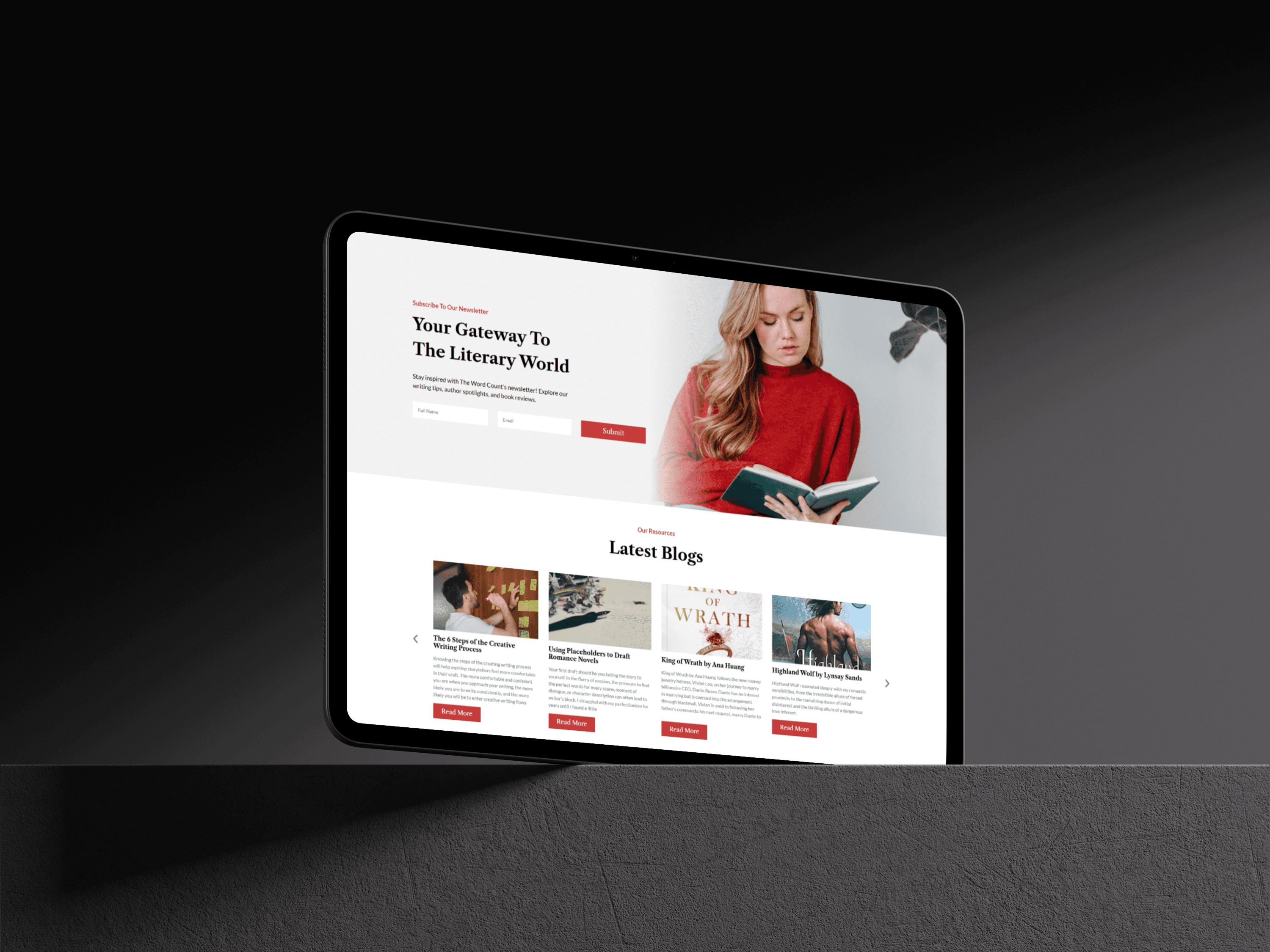
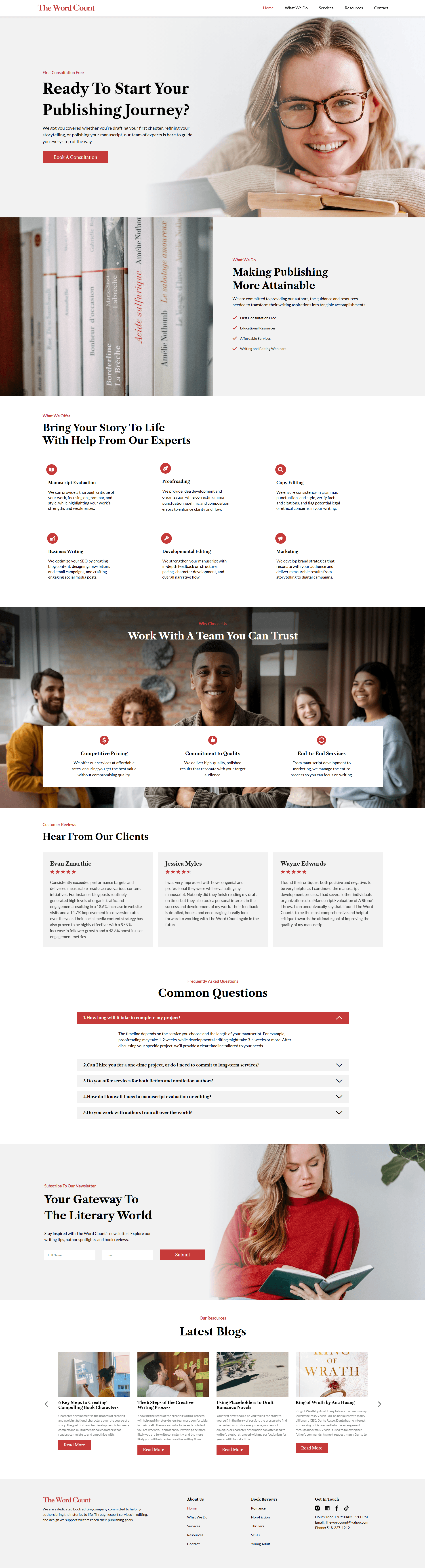
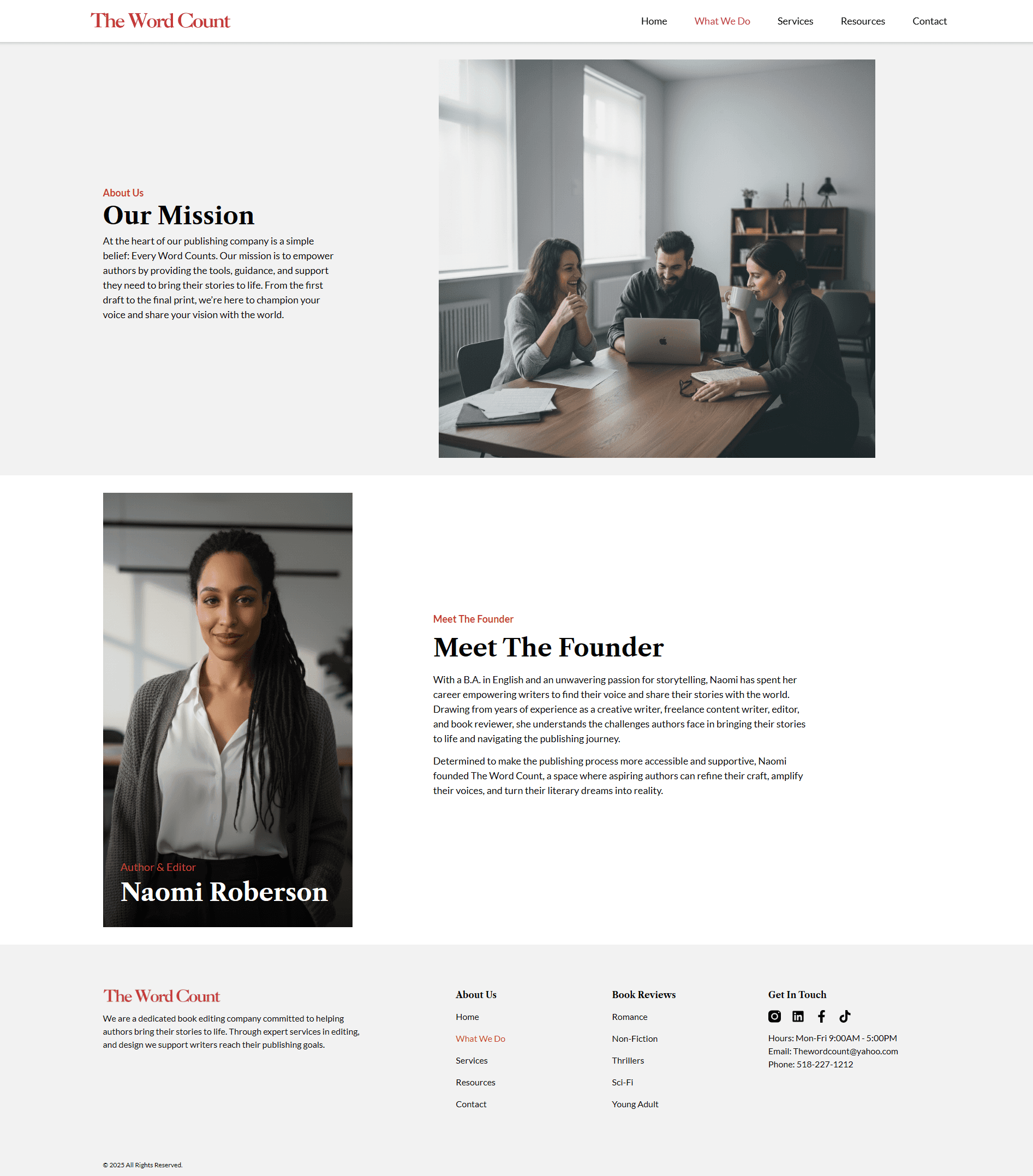
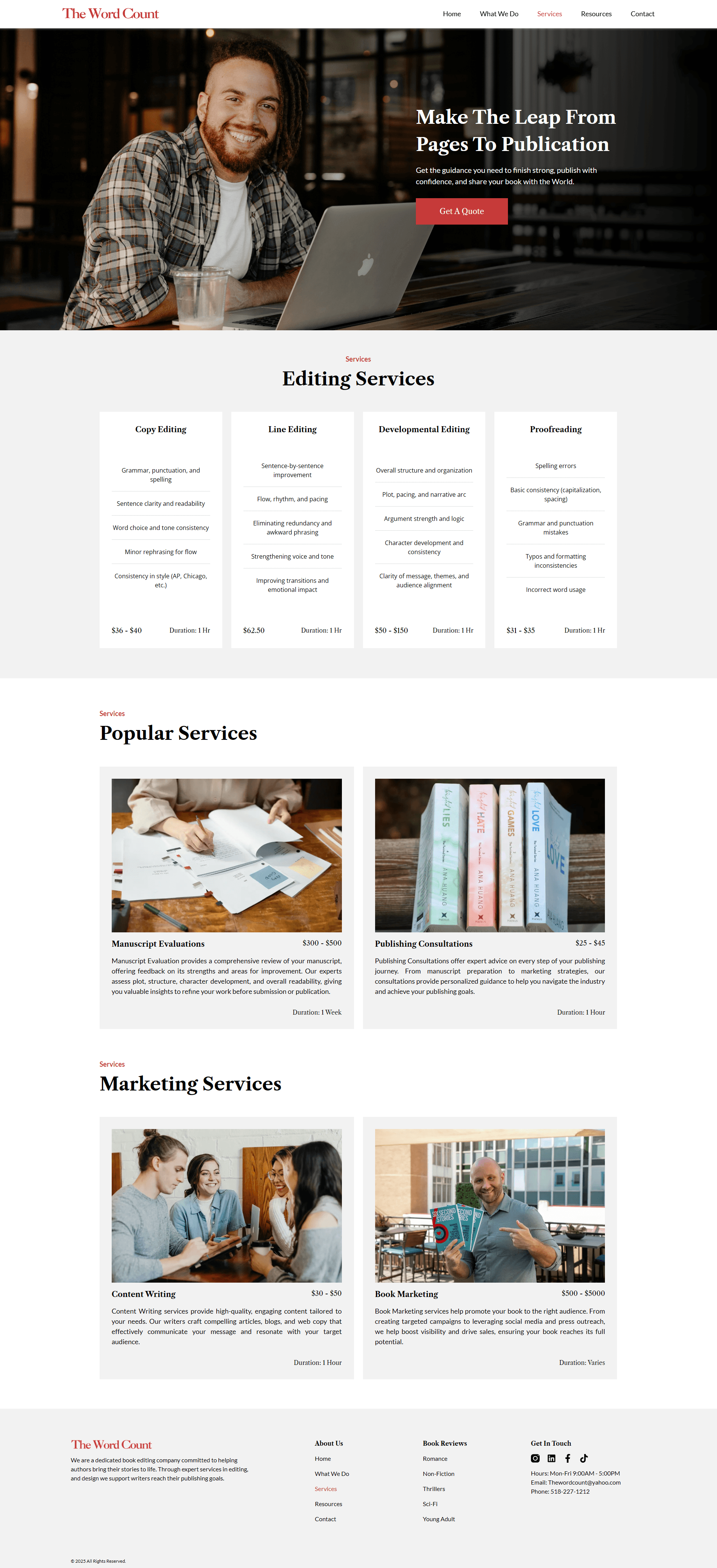
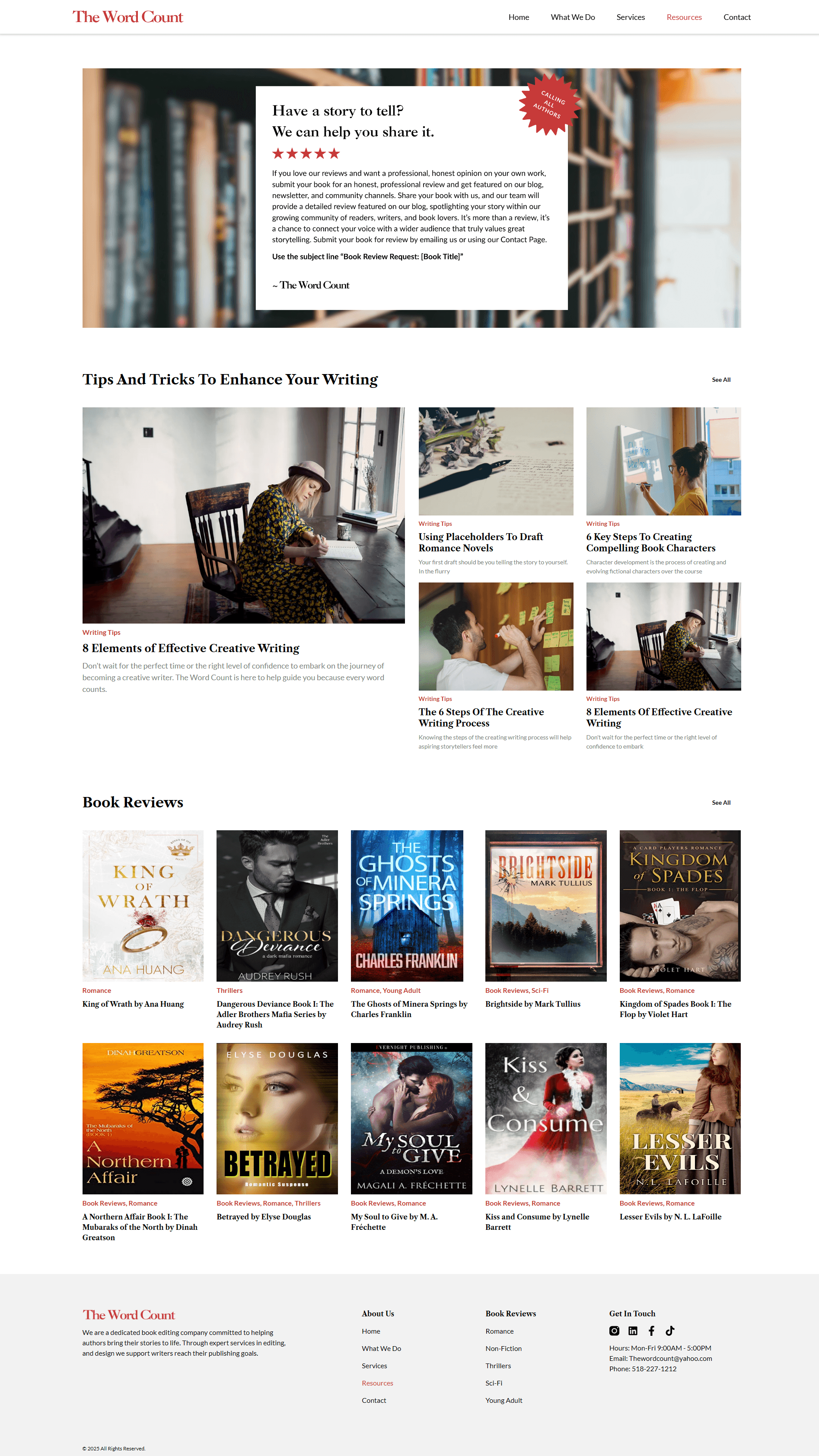
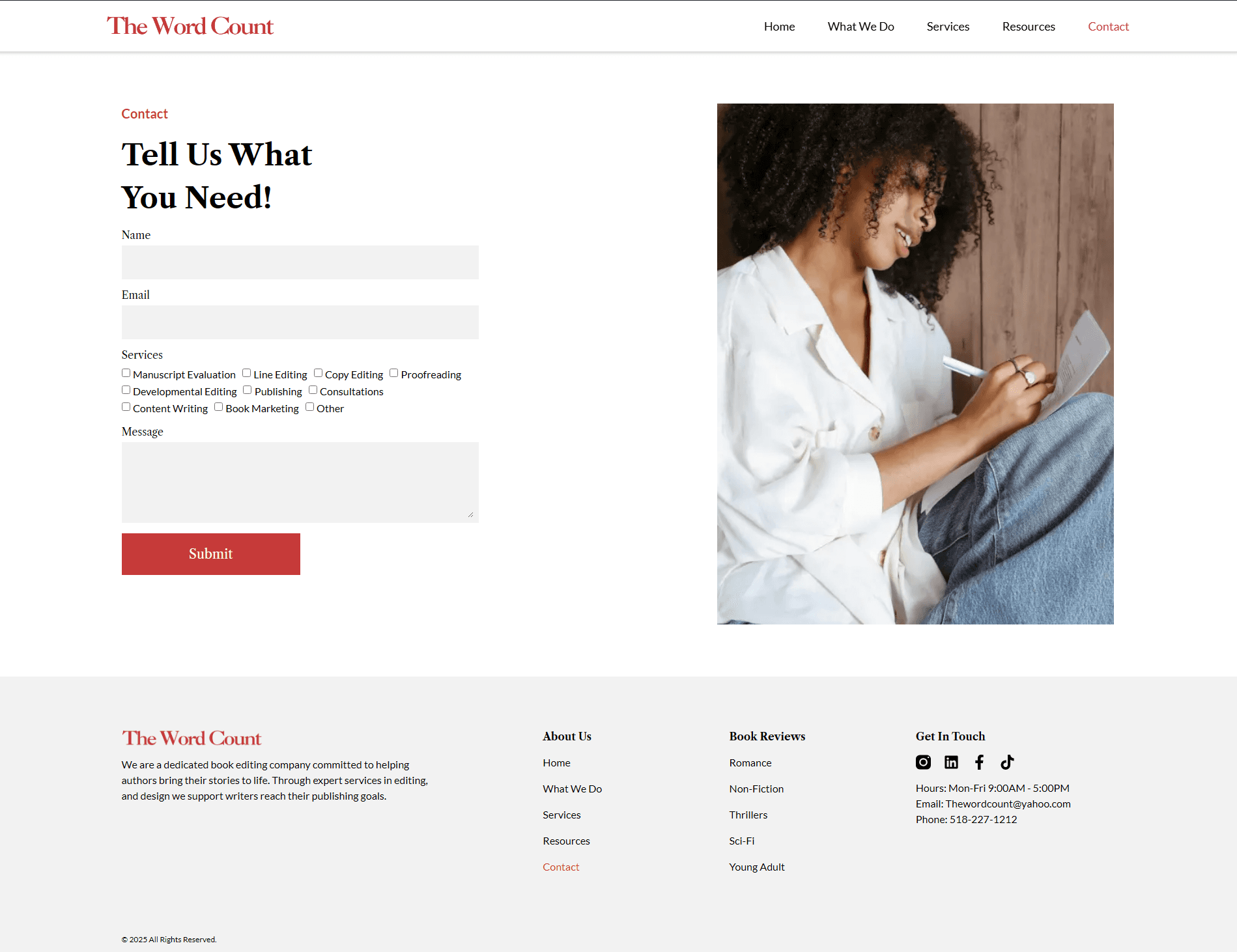
Final Product
Final Product
OUTCOMES
OUTCOMES
Business Impact
Business Impact
One year post-launch, site traffic increased by 36% and visitors grew by 12%, indicating stronger visibility and improved first impressions. Engagement with structured service pages confirms that information architecture and navigation enhancements successfully improved discoverability.
Before the redesign, there were no consultation inquiries. Following the redesign, users began actively engaging with the consultation call-to-action, establishing a measurable conversion pathway for the first time.
Overall, the redesign strengthened clarity, credibility, and engagement, with continued opportunity to increase conversion efficiency.
One year post-launch, site traffic increased by 36% and visitors grew by 12%, indicating stronger visibility and improved first impressions. Engagement with structured service pages confirms that information architecture and navigation enhancements successfully improved discoverability.
Before the redesign, there were no consultation inquiries. Following the redesign, users began actively engaging with the consultation call-to-action, establishing a measurable conversion pathway for the first time.
Overall, the redesign strengthened clarity, credibility, and engagement, with continued opportunity to increase conversion efficiency.
StudioCorke
StudioCorke
We are dedicated to creating strategic, human centered solutions that increase conversions and engagement for growing startups.
We are dedicated to creating strategic, human centered solutions that increase conversions and engagement for growing startups.
Company
Home
Work
Contact
Quick Links
Services
Case Studies
FAQs
Contact
Contact
(347) 500 - 4832
(347) 500 - 4832
studiocorke@gmail.com
studiocorke@gmail.com
Schenectady, New York, NY 12304
Schenectady, New York, NY 12304
© 2026 StudioCorke. All Rights reserved.
Terms of Service
Privacy Policy